Valentine’s Day Music

February 14 2018

Valentine’s Day is here again and around town Roses, Flowers and Chocolates are making their way from person to person in this day of affection.

For us Valentine’s Day is one of the four days that need some music, the other days are Christmas Day, New Year’s Eve and Australia Day.

There is millions of songs out there, songs like ‘Love Is All Around’ which was first made famous by the Troggs (they recorded ‘Wild Thing’) and then was a hit again for Wet Wet Wet.

Then you got songs by the likes of the Bee Gees, Taylor Swift, Elvis, Foreigner, REO Speedwagon and more, for every song picked there are many more in mind.

Valentine’s Day doesn’t necessarily has to be for couples, it could be the day a new relationship begins or it could be the day to express love or affection for people around you or it is a day etc.

Hopefully readers will find something in the videos below.

We end this playlist of love songs with a little bit of humor, the below song needs no introduction.

Happy Valentine’s Day readers.
TAFE campus is getting a new look

February 11 2018

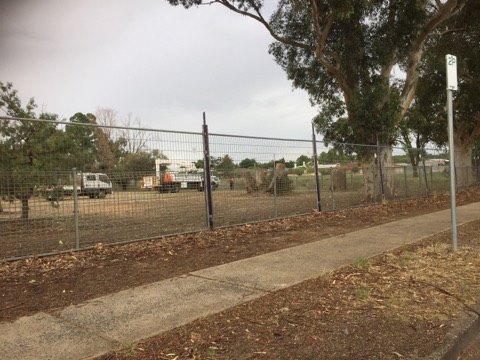
The TAFE campus grounds are getting a makeover with several of its trees along the campus border with Brown Park being cut down to make room for new buildings.

Temperatures in the mid 30’s and periods of high winds did not slow down the cutting down of the trees on Saturday afternoon.

It is great to see that the campus is getting more resources though we will miss the trees that were cut down as they provided not only shade but a place for quiet reflection and on occasion quiet time with significant others.

We will continue to report the progress of the modifications to the TAFE grounds as they come to hand.

Dan4.jpg

Work continues on The Globe

February 10 2018

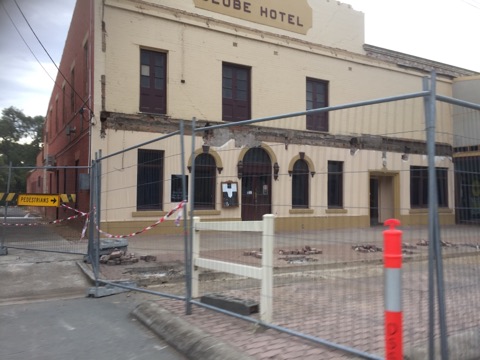
Work continues on The Globe with the building now looking pretty bare without its veranda/balcony.

Readers will see below three images of the ongoing reconstruction effort and they were taken by our photography wizard Daniel Clark.

This repair work has given us a chance to take a look at the bottom floor as it has changed little over the last century.

Dan3
Globe

It is a little hard to see in the scanned book picture but you can see the bottom of the hotel is virtually exactly the same with the only major changes being to the right hand side with the double doors and wider windows.

Dan2
Dan1
Those responsible for the dismantling of the damaged sections of the hotel have done a fine job in the short amount of time that has passed since the damage occurred two and a bit weeks ago.

It is always a relief knowing that nobody was seriously injured or killed when the town was hit by the storm that arrived quickly, packed a punch and departed the area within ten minutes.

We will continue to report on the reconstruction efforts as they come to hand.

The Historical Journey – September 30 1961

February 8 2018

Deniliquin’s railway history has been disappearing over the last couple of weeks as the remains of the platforms and turntable have been demolished to make room for an eventual retirement village.

The loss of the railway was considered a major blow when daily travel stopped in the late 1970’s and the occasional passenger train arriving after then was considered interesting as seen in this 1989 video.

In what could be considered ironic, a booklet became available online around the time the platform and tracks were being pulled up.

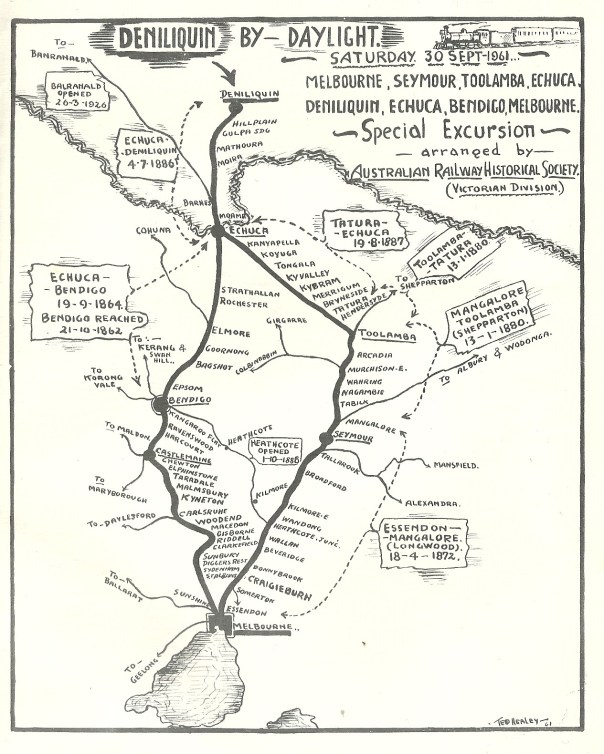
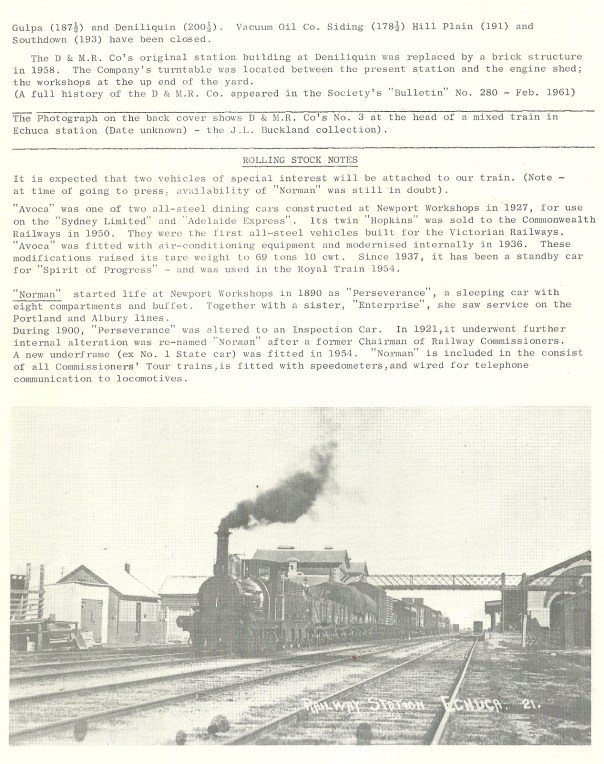
This booklet was was made for a Melbourne to Deniliquin rail journey on Saturday September 30 1961 arranged by the Victorian division of the Australian Railway Historical Society.

It was called ‘Deniliquin by Daylight’ and left what was called Spencer Street Station (now known as Southern Cross) at 6:50am and arrived in town at 3:45pm despite a listed time of 2:10pm, we know of the time difference thanks to notations penciled in the booklet.

They left Deniliquin at 4:37pm and got back to Melbourne at 11:28pm making it a very long day.

While the booklet is short, it has interesting details such as how many trains the railway operated, the brick Deniliquin station was built in 1985, the fact the rail line between Echuca and Deniliquin has only five curves in the 45 mile journey and the NSW Government brought the line in 1923, gave it to Victorian Railways but the cost was paid for by the Victorians.

Below is all four pages at the best possible resolution so everyone can read it, can anyone spot the error on the front page?

scan0002.jpg
scan0004.jpg
scan0003.jpg
scan0001.jpg

Deni Speaks (6/2/18)

February 6 2018

Over the last couple of weeks, we have asked readers questions on the local economy and what their highlight was from DNS’s array of reports and stories.

How is the local economy going?

It is on a downturn – 40.91%
It is going steady – 31.82%
Anyone got a paddle? – 27.27%
It is thriving – 0%
It is going great – 0%

In terms of the economy is going good vs neutral and going bad, just over 68% of voters voted for the the economy is going bad options with 31.82% going neutral and 0% saying it is either going great or thriving.

Your favourite DNS story of 2017 is……..

Deniliquin’s Hotel History – 35%
Images of Deniliquin – 25%
‘Return and Earn’ – December 1 2017 – 10%
It’s Back!!!!!!! – 10%
Exploring Deniliquin in 2008 – 5%
Shopping revolution coming to Deni – 5%
Deniliquin from the air – 5%
Election Complication – 5%
ERC Election Wrap – 0%
Hunting down the Lyceum Theatre – 0%

Deniliquin’s Hotel History which is our biggest post in terms of word length is the favourite of readers with 35% of voters selecting it.

‘Images of Deniliquin’ which was a look back at historical images of landmarks that are now mostly gone received a quarter of the votes.

Conclusion

Confidence doesn’t seem high from the 22 answers we received and the recent stock market plunge will probably not boost confidence at all but it would be interesting to return to the question in May to see if more people answer and if things get better.

2017 was a good year for DNS, we learned that people loved knowing about events, reading a good joke on April 1 and looking through a history that is slowly fading away in terms of physical traces like the railway platforms that are now gone.

If you have a question you’d like answered and it is tasteful, let us know and we’ll put it up.